
Amiri Sizing Denim Chart Rock Luxe Aesthetic
AMIRI for Men: Structuring a Wardrobe Around the Brand
Because AMIRI is a Los Angeles house bound to craft denim, deconstructed and repaired where it shows, that fact sits at the centre of any plan you make. The label is expensive enough that assembling a wardrobe piece by piece, with a plan, beats taking whatever turns out to be in front of you. Rather than a shopping list, this guide frames amiri clothing as a small set of anchors. Each figure here is an observed market price drawn from 2026 retail listings, not an official price list. The target is a rotation that reads as deliberate at three very different spending levels. It assumes a handful of pieces rather than a full closet.
What You Are Buying Into
By the house’s own account the start is 2014, when Mike Amiri established the label in his hometown of Los Angeles; the CFDA lists the same year. Against that sits the earliest contemporaneous document, a December 2014 press release dating the founding to 2013 in partnership with the Los Angeles concept store Maxfield, so the year remains something nobody has settled. The debut was an exclusive capsule at Maxfield, which is why early pieces are rarely seen. Amiri began hand-crafting stage pieces for what the brand and the CFDA describe only as legendary Los Angeles performers; retail editorial has named specific rock clients, the label has never done so. He retains majority ownership, with the Italian group OTB, chaired by Diesel founder Renzo Rosso, holding a minority stake acquired in 2019 on undisclosed terms. It showed at Paris Fashion Week from 2018 and presents there twice a year, yet remains an American house that put menswear first, with womenswear arriving in 2021.
The Three Anchors
A workable version of amiri men’s dressing narrows to three anchors, a single jean, a single shoe and a single jersey piece. The three carry distinct shares of amiri the brand’s identity, and a bad choice fails differently in each. The craft is most visible in denim, which is also where the budget lands. The bones motif runs across every category, and footwear is where it is visible from far off. Jersey leaves the work to the logo, which makes it the simplest place to buy too much. Buying one of each, in that order, leaves you something wearable long before you have spent an outfit’s worth.
Denim at the Front
Signature status goes to the MX1: skinny-fit, Italian stretch denim, hand-distressed, repaired with pleated ovine leather, observed at $1,090. At $750 the Stack is the obvious entry point into core amiri jeans, and its inseam is deliberately long, engineered to concertina at the ankle. Read that extra length as the design rather than a fault; it should not push you into a smaller size. Where the MX1 is defined by its leather panel, the Thrasher is nothing but abrasion and repair, and the Shotgun runs blown-out, sanded-edge holes across straight-leg and skinny versions. If the skinny cut does not suit you, the Carpenter, Washed Baggy and MA Fit silhouettes are roomier, observed between roughly $705 and $1,345 before markdowns. Bandana and Crystal are treatments applied across these models, not fits in their own right.
Then Footwear
House signature sneaker is the brand’s own wording on the Skel Top Low, a leather basketball silhouette finished with hand-cut bone appliqués in contrast topstitching. It is observed at $650 on the official site, having released at $590 in August 2020, so articles quoting the lower figure are stale. Production is in Vietnam, which is normal for the footwear line and not a sign that anything is wrong. The Skel Court is its own model, canvas and retro-court in shape, observed at $690, and the Stars Court replaces the bones for star appliqués, refreshed for Pre-Spring 2026. Here the MA-1 means a sneaker, observed at $799, and not a bomber jacket, even though the designation belongs to military outerwear in other contexts. Boot buyers get the Ryder, priced from $1,090 in leather through $1,190 in suede to $1,290 python-embossed.
Then the Jersey Piece
The MA Core Logo Hoodie is the reference point, cotton with the MA icon and core logo, called a normal fit and observed at $650. It is made in the USA, as the MX1 and Stack jeans are, which is where the manufacturing story is straightforwardly true. Because an amiri hoodie sits among the most counterfeited shapes in the line, provenance carries extra weight in this category than anywhere else. At authorised retail, tees run from roughly $425 for simpler graphics up to about $930 for heavily worked pieces. The MA Core Logo Tee and the MA Bar Logo Tee are different products and constantly confused; the first is made in Italy, the second in Los Angeles. Observed above $1,300, zip hoodies with varsity patchwork cost what a jacket costs, which is a fair reason to buy the plain one first.
Three Routes on Budget
Below, three routes reach the same wardrobe at very different costs, and every figure is an observed market price rather than any official price list. Route one buys new at full price through the brand’s own channel, and what the premium buys is assurance. The second waits for authorised sale periods, which is realistic because discounting here is structural rather than occasional. In-season markdowns of roughly forty to seventy percent are visible at multi-brand stockists, with further reductions through off-price arms. The third mixes one new anchor with secondhand, which lowers the total sharply but shifts authentication risk onto you. None is better in the abstract; they trade money against certainty and patience, and the anchor order stays the same.
| Route | Anchor set | Observed outlay | Main trade-off |
|---|---|---|---|
| Full price, official channel | Stack jean plus Skel Top Low plus MA Core Logo Hoodie | $750 and then $650 twice | Most expensive, best provenance, complete size runs |
| Authorised sale season | The same trio, previous season | Roughly 40 to 70 percent off list at multi-brand stockists | Depleted size runs and last season’s colours |
| New anchor plus secondhand | New sneaker, secondhand denim and jersey | MX1 listings observed near $400 to $840 against $1,090 retail | Authentication risk falls on the buyer |
Fit Notes That Alter the Order
Everything in this section is buyer-reported and retailer-guide material, because the brand does not publish complete garment measurements style by style. Fit guides call the core skinny jeans, meaning MX1, MX2, Thrasher and Stack, close to spray-on, and they are cut deliberately close. Waists run true to the labelled size, while the leg is what creates the returns; buyers with muscular thighs or calves commonly report going up one or two sizes. Ready-to-wear runs slightly trim, and the usual advice is one size up, except on pieces already named oversized, where sizing up compounds. The Skel Top Low is reported true to size, the brand advises rounding a half size to the nearest whole size, and official sizing runs from 40 to 48 in European numbers. Stop that note at the Skel Top Low; for the other models no consistent reporting exists.
Buying Without the Burn
One official e-commerce channel, the brand’s own website, is the whole of it online, with roughly thirty-three owned boutiques offline, several marked as coming soon. About thirty-one is the standalone count in trade reporting, and the far larger numbers that circulate, including a claim of one hundred and ninety-five stores, confuse wholesale doors with owned shops. On the authorised multi-brand side sit Saks Fifth Avenue, Neiman Marcus, Nordstrom, Bergdorf Goodman, Maxfield, Harrods, Selfridges, SSENSE, Mr Porter and Mytheresa. Farfetch is the one that needs explaining: missing from that official online list, yet carrying deep stock through partner boutiques that are stockists in their own right. Anyone typing buy amiri online should use the stockist page as the reference, noting it is not closely maintained and still names a retailer that closed in 2024. Because there is no outlet, online or physical, a site presenting itself as one is not the brand, and the only genuine discounted stock sits in authorised sale sections and off-price arms.
Widening the Rotation
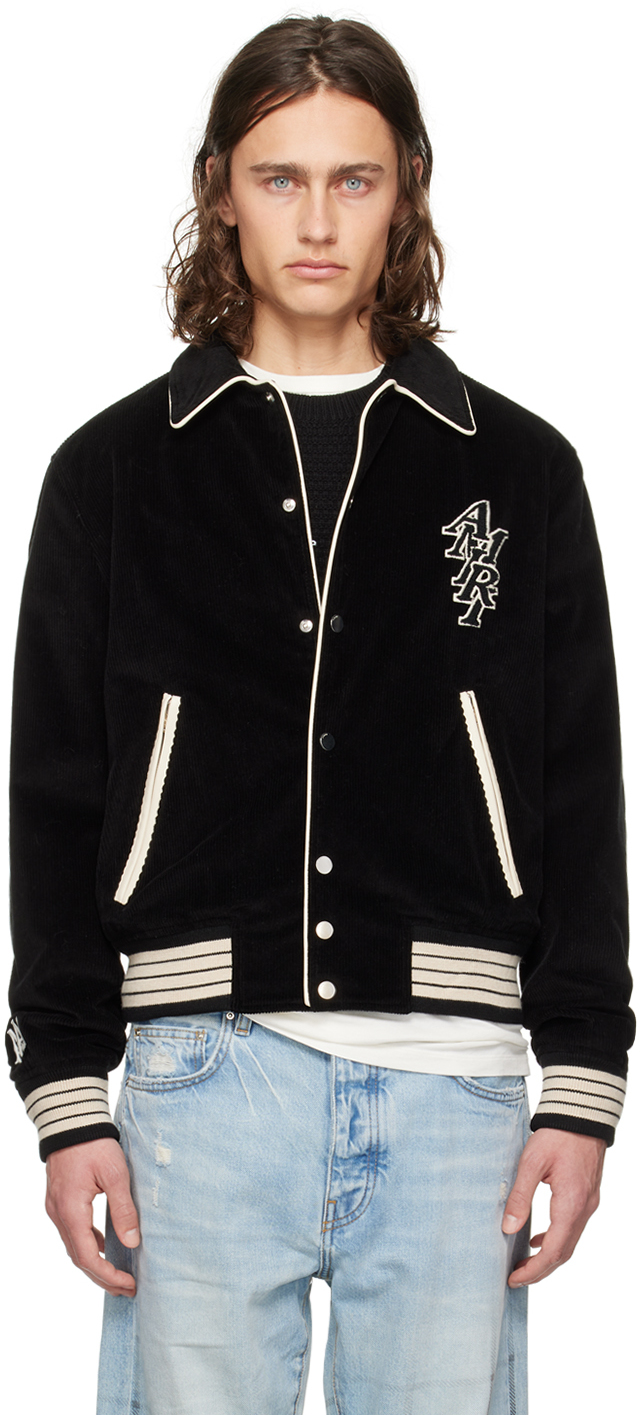
Once the three anchors are in place, useful additions change the shape of an outfit rather than repeat it. Flannel counts as a founding pillar; a bleached quad-motif flannel has been observed at $1,290, outerwear money for sleeves that are not a hoodie. Denim outerwear is the natural fourth piece, with repair work jackets and studded truckers observed between roughly $1,815 and $1,880 at list and less on sale. Varsity jackets are the loudest option and the most seasonal, observed above $2,300 at list. The line also covers accessories, hats, small leather goods, eyewear and bags among them, although belts are not a standalone category. The name amiri now covers everything from kids’ pieces to handbags, and the wardrobe that works is the narrow one: buy slowly, keep the invoices, and let the denim carry the outfit.